

Are you interested in thermoforming and looking to expand your knowledge base about vacuum forming machines? If so, you have come to the right place.
For anyone needing a quick refresher, vacuum forming is a popular manufacturing method used to make hollow, three-dimensional objects.
It involves heating plastic sheeting to a pliable temperature, stretching it into or onto a mold, and forcing it against the mold using a vacuum.
The goal of this blog is to familiarize readers with the thermoforming machines that carry out this process. To get started we will focus on large-scale models.
Industrial Vacuum Forming Machines

Industrial vacuum forming machines are used for high-volume production runs to successively manufacture detailed plastic products and parts. They vary considerably in terms of size, complexity, and production capabilities.
Modern, computerized thermoformers combine techniques drawn from mechanical and electrical engineering. Some machines are manually operated, and others are semi-automatic or fully automatic.
Depending on the machine’s size, it will have either a single or double infrared heating element.
A single heater machine has an overhead oven that heats the material from one side. Whereas a double heater machine has a top and bottom oven that simultaneously heats both sides of the plastic.
Machines with dual heating elements have the fastest cycle times and can be adapted to accommodate both male and female molds.
Types of Thermoforming Machines
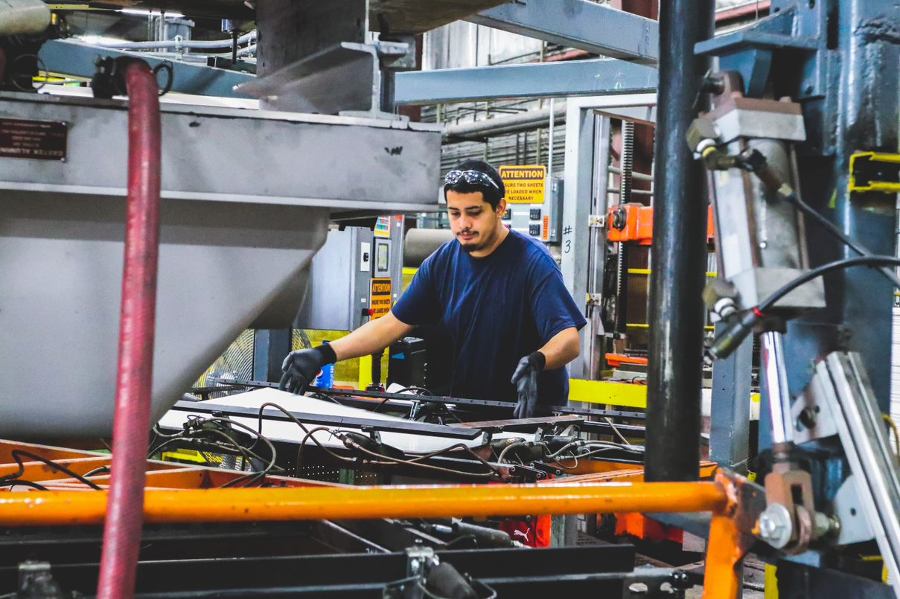
The exact method used to form a part depends on how the plastic is fed into the machine when it comes off the extruder.
Rotary and shuttle machines are both sheet fed. Rotary machines have multiple stations that allow different functions to be performed at the same time.
For example, if a machine has three stations, a plastic sheet can be loaded at one station, another sheet can be indexed to the oven at a second station, and a third sheet can be forming and cooling at a third station.
Inline or roll fed thermoformers are higher output machines than sheet fed models. They work in an automated, continuous process and can be run directly from an extruder.
Inline formers are designed to minimize heat loss when plastic transitions from the extruder to the former.
All rotary, shuttle, and inline formers have minimum and maximum sheet thickness limitations.
Here at GPI, our minimum sheet thickness is .065” and our maximum thickness is approximately .5”.
How Vacuum Forming Machines Work
Outlined below is a general overview of how a large format thermoformer works.
Initial Setup
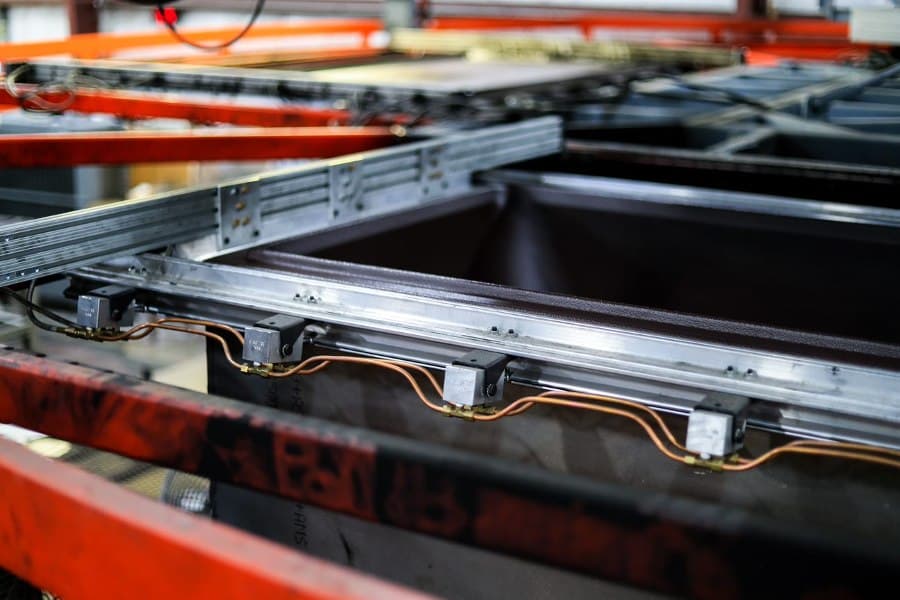
Every machine has a perforated forming surface (platen) that holds the mold in place and a clamping frame that holds the plastic sheeting.
Before vacuuming can begin, the mold is fastened to a board-like platform, which in turn gets fastened to the platen.
Next, the mold is lowered or raised into the clamps holding the plastic sheet. The frames are then adjusted or changed out to accommodate the size of the mold.
Heating

Once the plastic sheeting is loaded into the machine and the heater(s) are positioned, the material is sent through the oven(s) at increasing temperatures and time intervals.
A pyrometer monitors and adjusts the material’s temperature as it passes through several heating zones.
Some machines are equipped with a photo-electric beam that gets projected into the heating chamber to keep the plastic level. If the material starts to sag, pressurized air is blown into the oven to lift it back to the correct position.
When the plastic reaches the predetermined forming temperature, it is smoothed out to an even consistency.
Vacuuming and Forming
After the plastic is rotated out of the heater and into the forming station, the platen lifts (or lowers) the tool into the plastic.
When needed, a plug assist will push extra material further into the mold so it reaches the deepest areas of the part.
An external vacuum pump is then activated to suction the sheeting around the mold and remove the air trapped between the mold and plastic. This causes the material to pull against the mold and take shape.
Cooling
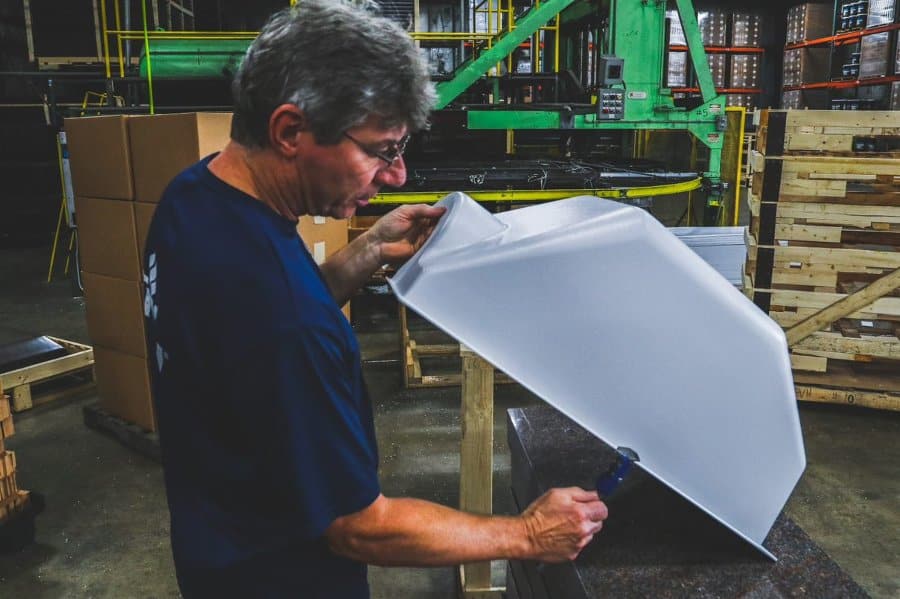
The cooling process is done gradually and consists of several stages.
As the tooling comes out of the machine, its temperature is regulated by a computerized control unit.
While the vacuum is still on, internal high-speed fans cool the newly created part until it becomes solid. This process will be accelerated if a mold has internal water lines.
When the part has properly cooled, the vacuum stops and compressed air is pumped through the mold. The platens are then taken away and the object is removed from the mold.
Lastly, the machine rotates the part into the loading station where it is given additional time to cool before being trimmed.
Other Types of Vacuum Formers

There are several other types of vacuum forming machines available on the market used for different purposes.
DIY Former
Basic vacuum formers can be built in non-industrialized settings. Such machines are not compatible for mass production but can be used for small jobs as well as educational purposes.
DIY models are easy to set up, handle, and maintain. The main drawback is they have slow response times and are not sophisticated enough to use complex tools.
Tabletop and Desktop Formers
Small businesses, students, and at-home professionals typically use tabletop and desktop machines.
These apparatuses have advanced operating systems that don’t require extensive training to operate.
They are best suited for making simple acrylic parts such as small bins, trays, and frames.
Mid-size Stand-alone Vacuum Forming Machines
A step up from tabletop models, mid-size stand-alone machines have the ability to manufacture larger parts without taking up a lot of floor space.
Mid-size machines are often used for proofing design concepts and prototyping. They combine the ease of use of desktop models with the functional capacity similar to those of more sizable machines.
These machines are well equipped with automated features that support quality control.
Wrap Up

The thermoplastic industry is evolving at a rapid pace.
As economic times change, competition elevates, and customers push for the highest quality parts at lowest possible price points, we will start to see vacuum forming machines become more advanced.
GPI understands the importance of investing in state-of-the-art equipment. We have a total of 8 vacuum forming machines including 7 rotary machines and 1 shuttle machine.
Our thermoformers are custom built to take on the most challenging projects!
If you have questions about our machinery or would like to know more about our processes, don’t hesitate to contact us.
Have a product you need developed on our vacuum forming machines? Provide us your specifications and request a free quote today!