


Injection molding and vacuum forming are versatile manufacturing techniques that are used to make a variety of lightweight, durable plastic products and parts.
Both methods involve the use of molds, require extreme heat, and are overall very cost-effective. Despite their fundamental similarities, each process has a very different approach.
This blog post will compare and contrast vacuum forming vs injection molding, highlighting the advantages and limitations of each process.
Processes

Vacuum forming, which is a type of thermoforming, involves placing thin plastic sheeting in an industrial-sized oven and exposing it to high temperatures.
Once the material becomes soft and malleable it is stretched over a male mold to contour the inside dimensions of the part or placed inside a female mold to form the outer dimensions of the part.
After it has cooled, the newly formed three-dimensional object can be released from the framework.
With injection molding, plastic pellets are fed into a hopper, heated, and melted into a liquid state.
Using immense pressure, the material then gets injected into a double-sided mold where it is given time to cool and solidify.
Once complete, the two halves are simultaneously opened allowing the molded part to be released.
Both vacuum-formed and injection molded parts will need to be trimmed and may require additional secondary operations such as sanding and smoothing.
A part can also be painted, silk-screened, or stenciled to enhance its appearance.
Capabilities

Vacuum forming is used to produce relatively simple geometric objects of all sizes. The process offers a lot of opportunity in terms of special design features.
And since shaping is precisely done in one direction, all resulting products and parts are hollow.
Job orders are typically for shorter production runs and range roughly between 250 to 2500 units annually. Vacuum forming has the unique capability of being able to produce large scale items without slowing down lead times.
Injection molding is generally used in mass-production processes where smaller identical parts are successively produced thousands or in some cases, millions of times.
It has the capability to produce very detailed objects with a high degree of accuracy. Due to the fact that liquid polymers are injected inside a dual-sided mold, there aren’t any shaping restrictions.
From a design standpoint, injection molding allows for a little more creativity than vacuum forming and is better suited for intricate objects with gauge variations.
Vacuum forming, on the other hand, lends itself well to in-process modifications, achieves higher tolerances, and can create shapes with thinner walls.
Resulting Parts and Products

Vacuum forming and injection molding are both effective ways to create lightweight plastic objects with predetermined, fixed forms.
The type of part and its specification requirements must be factored in when deciding which method is best.
Vacuum Forming
- Industrial containers and pallets including airline tubs, railroad containers, and many types of trays
- Contoured packaging for hygienic products and beauty supplies, cleaning agents, food and beverages, etc.
- Exterior casing for fax machines, printers, and computers
- Automobile dashboards, bumpers, interior panels, and air ducts
- Aerospace components and equipment
Injection Molding
- Construction materials such as flooring materials, vents, and deck panels
- Accessories for point-of-purchase displays – product stops, dividers, hooks
- Electronic parts including protective exterior housing and interior components
- A large variety of commonly used consumer goods
- Disposable healthcare supplies – surgical equipment, diagnostic kits, visors, syringes
Tooling & Production
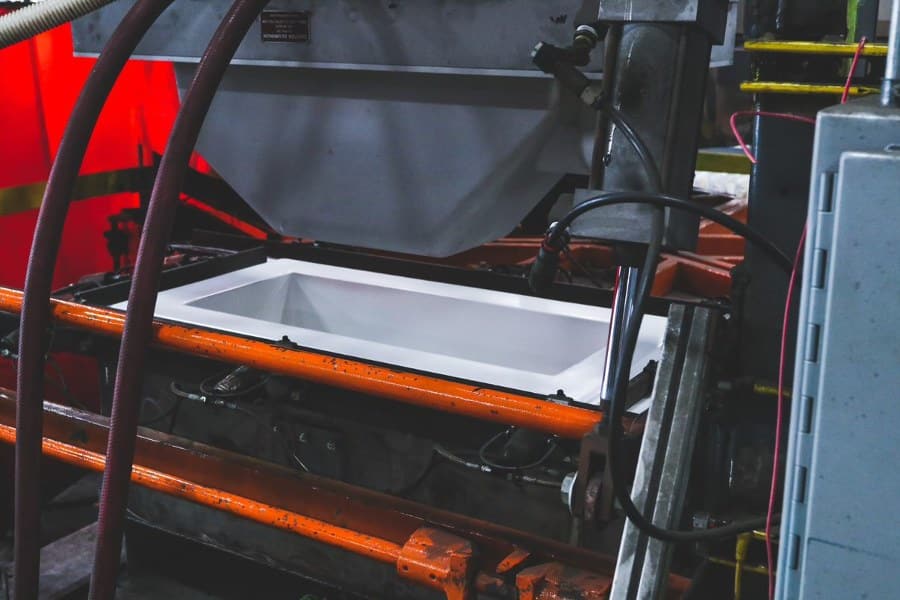
A minimal amount of upfront engineering is needed to develop tooling for vacuum forming. Molds can be made from inexpensive, soft materials and are usually created within a matter of weeks.
For higher production runs, aluminum water-cooled tooling is preferred.
When the time-to-market window is small, vacuum forming is usually the preferred method.
The tooling used in injection molding is made from harder materials such as stainless steel, aluminum, or alloy metal. Such molds are costly and can take months to produce.
Depending on the part’s surface area and the size of the clamp frame, tooling can be two to three times more expensive than vacuum forming tools.
On the production side, vacuum forming has higher per-piece costs than injection molding. But because of the expensive tooling, it only makes sense in high volume manufacturing.
A vacuum formed part’s cost per piece becomes continually less expensive as the quantity increases. Higher volume jobs with shorter lead times will also make the process more cost-effective.
Comparison of Key Differences

Closing Summary
Vacuum forming and injection molding each have their own distinct set of benefits and one method is not necessarily “better” than the other.
However, as technology continues to evolve, the gap between the two processes’ applications and capabilities will become smaller and smaller.
Now that we have taken a closer look at vacuum forming vs injection molding, you hopefully have a firm grasp on the capabilities and considerations of each process.
If you have a question that has gone unanswered, feel free to contact us or leave a comment below.


3 Responses
Good article! We did some filming on injection moulding with Arburg a few weeks back, – Luke
Thanks, Luke! We appreciate you taking the time to read and leaving feedback. Best of luck in your filming endeavors.
Thanks for reading the article and sharing your comment. We are glad you found it informative.